Powered by Blogger.

Entries

Social Links and Banner Link


Wine to me is passion. It's family and friends. It's warmth of heart and generosity of spirit. Wine is art. It's culture. It's the essence of civilization and the art of living. - Robert Mondavi
Showing posts with label InformativeWineBlogPosts. Show all posts

Why does wine pair so well with cheese?


Have you ever wondered why wine and cheese taste so good together?  Is it one of those social norms that we’ve all grown accustomed or is there real science  behind this perfect match?  As with most wine related phenomena, the magic of its pairing with cheese is good old chemistry.   It starts with recognizing two very important qualities that are found in wine: tannin (found in grape skins, stems and seeds, this causes your mouth to feel a dry, chalky sensation, akin to drinking black tea) and acidity (this is what causes your mouth to pucker and causes you to salivate when you drink certain wines).  Cheese, by nature, is creamy, fatty and also contains proteins which when consumed, coat the palate of your mouth.  Your taste buds enjoy this sensation of oily, creaminess at first, but then crave balance, and both tannin and acidity help cut through the fat coating to “cleanse your palate”.  So if you’ve been indulging a bit too long at the cheese table, you may even crave wine!
The same is true in reverse.  Wines that have a high level of tannin can be harsh to drink and overpower some of the subtle flavors in a wine.  When a tannic wine is consumed with cheese, however, the proteins and fat in cheese start to break down the tannin and coat your palate protecting it from the harshness of the tannin.  This is akin to why people add milk or cream to their black tea in England.  If you want to conduct a fun science experiment, start with a bold, tannic red wine.  After tasting it, drop a cube of hard cheese into it and let it sit for a minute or two.  Then re-taste the wine; I guarantee you’ll notice that it tastes smoother.  You’ll also notice that the hard cheese has turned purple as it has been absorbing some of the tannin from the wine!
White wines don’t have tannin, so why do they also pair well with cheese? Many white wines have good acidity, which is an astringent and also helps cut through creaminess.  Crisp acidity, and effervescence that is found in sparkling wines is also a great counterpart to salty foods, which is why it pairs nicely with salty cheeses.  While some experts believe wine and cheese should be paired according to region or strength, I have a few general guidelines that are simple to follow and lead to matches made in heaven:
  • Pair creamy cheese with high acid wines like a sauvignon blanc or a riesling.  
  • Soft, fresh, cheeses pair nicely with a fruity wine (pinot grigio, chardonnay).  
  • Rich, heavy cheese (like Havarti or feta) pair well with a light red wine or full bodied white, like a Gewurztraminer.  
  • Highly tannic wine pair well with hard cheese, as you now know from the experiment I noted above.
  • And for a sweet and savory finish, try a strong, blue-veined cheese with a dessert wines (port, sauternes).

So the next time you’re enjoying a beautiful cheese course consider wine over other alternatives and  when you’re a few glasses of wine in at a party don’t forget to say cheese! For more Wine 101, follow my "Ask the Somm" posts on WhichWinery.
Read more »

OneHope - One impactful wine


It was the flashy, pink glittery bottle of champagne that drew me in at a Battery member wine tasting event in San Francisco. I’ll admit, I’m attracted to shiny things and the bottle screamed “I’m sexy, I’m unique, I’m fresh and perfect to bring if you want to make a splash at any occasion”.  Later on, I couldn’t get the glitter bottle out of my mind, so I took to my computer to do some research on how to get my hands on one of those bottles. As I explored the OneHope site, I realized that this wine, much like Reese Witherspoon in Legally Blonde, was much MUCH more than a pretty package…its mission is not pure consumer delight, but to positively impact an array of causes, giving back with every bottle.


OneHope was founded by 8 optimistic twenty-somethings who decided they wanted to use a favorite indulgence (wine) for good cause, donating proceeds from every wine purchase towards a unique charitable cause.  Similar to the Toms or Warby Parker “buy one give one” craze of the past decade, this younger generation of winemakers isn’t content to just produce good product with sleek packaging, but seek to also raise awareness and make an impact in the world through every bottle of wine sold. OneHope donates 50% of the profit from every bottle sold to their specified causes and as of this blog post, has already made more than $2 Million in donations, supporting over 12 causes, each measured on impact (i.e. each case of Chardonnay sold represents one clinical trial for a woman with breast cancer). Causes include autism and breast cancer research, microloans to help break the cycle of poverty, placing sheltered animals in new homes, vaccinating children to prevent deadly illness, planting trees to help save our planet and providing clean drinking water to people around the world. OneHope has also established another way to generate money for causes; if you host an at-home tasting with ViaOneHope (their direct sales community), 15% of the sales from that event can go to a local charity of your choice.  


But it gets better. The wine actually tastes good.  So good, that it’s ranked the #1 selling wine out of 10,000 wines available for purchase on Amazon, has received multiple 90+ point ratings, and has been rated one of the top 300 wineries by volume of 8,000+ in the US!  Key to the wine’s quality and success? Back in 2009, Michael Mondavi, one of the pioneers of the Napa Valley wine industry, met the young founders at a tradeshow and offered to help them.  Today, Rob Mondavi Jr. is a consultant winemaker for the brand and produces a product that’s consistently high quality and actually affordable too. R.M. Jr. does all of the sourcing for OneHope and has helped expand the portfolio of wines to include grapes that come from Monterey, Paso Robles, Edna Valley, Lodi, Sonoma Coast, etc.  Since OneHope wants anyone to be able to afford and enjoy their wines, they have a moderately priced core collection, and have expanded to Reserve tiers and special editions (including the Glitter bottles!)


I haven’t yet visited OneHope in person, as it’s undergoing construction and will not be finished for another year and a half, but I am eagerly awaiting the opening and looking forward to a “hard-hat tour” before it’s officially open.  The winery has been designed by renowned architect, Howard Backen, iconic in wine country for designing Meadowood and Harlan Estate, and will be located on a prime piece of real estate in the heart of Napa wine country off of Highway 29 in Rutherford across the road from Cakebread and a neighbor to the iconic Mondavi Winery.  The 15,000 sq. foot winery facility is intended to be a community hub, great for social gatherings, exhibits and tributes to the causes supported. The design will feature lots of windows and glass doors to bridge the outdoors with interior, wrap around porches, and a large private barrel room and tasting room open for public tasting. It will be named "Estate 8" to symbolize the 8 partners that founded it, to represent the infinity sign, in all of its symmetry and infinite cycling of resources, and to pay homage to the Chow family that the winery was purchased from, since 8 is a lucky number in Chinese culture. OneHope is not just a producer of wine, but rather a lifestyle brand that you will want to be part of, especially if you embrace the company’s credo: “Make giving back part of what you do every day”.


Wines I sampled*

*Fun fact: the dots on the bottles aren’t just a pretty decoration, rather they’re a statistic representation related to the cause supported by the bottle; i.e. 1 in 7 children do not know where their next meal is coming from in the US, hence, 1 in 7 dots is filled in on the Sparkling Brut.  For every case of the Sparkling Brut sold, 25 meals are donated through the charitable partner, WhyHunger.


Rutherford Estate Sauvignon Blanc: A unique sauvignon blanc that is aged in oak yet remains crisp and fresh. Notes of tangy citrus, stone fruit, and tropical fruits are balanced with a bite of crisp green apple. Really intense fruit flavors and aromatics.


California Brut Sparkling Wine: Crisp, light, wine with a nose of green apple filled croissant .  The body has light fruit flavors of gooseberry, white peach, baked bread and prickly pear. Refreshing and perfect for summer.


California Chardonnay: A warm, rich Chardonnay with aromas of baked apple pie sprinkled with baking spices.  On the palate, buttery caramel apple, vanilla bean toffee and crisp pear.


California Cabernet: A deep hued cabernet with nice tight structure and hints of blue fruits to match the bottle. Notes of blackberry cordial, coffee, dark chocolate and some dried tobacco. Some secondary notes of leather and roasted plum make for a nice finish.

California Pinot Noir: A bright, layered pinot with notes of red fruits, wild strawberries and bing cherries on the nose and palate. Secondary flavors of fall leaves, spices and violet make this wine interesting and rich with a nice finish.
Read more »

Tasting In the Dark - Vintner's Collective at Tout Suite Social Club


I was honored to recently be part of the August monthly tasting panel for Tout Suite’s Tasting In the Dark series. On the first Monday of every month, a talented local wine merchant selects a special flight of 6 wines, sometimes themed, sometimes not (past merchants have included Oxbow Market, Dean and Deluca, St. Helena Wine Center, etc.). The Tasting Panel participants (typically three total) have 15 minutes to evaluate the wines blindly as the cyber audience views and can participate via livestream. Wines are swirled, chewed, smelled, and rated by the panelists. By the end of the 15 minutes, the panelists deduce a score for each wine based on aroma, appearance, taste, finish, and overall drinkability.  While the panel makes their deliberations, host Matthew Simpson comments on the personality and style of the panelists in attempts to derail their concentration, while concurrently interviewing the wine merchant of the month.
This month’s August tasting, featured Garret Murphy of Vintner's Collective. Sommelier Woody Van Horn of Bouchon (formerly Goose and Gander) was a featured panelist. To make things even more interesting, the third panelist was replaced at the very last minute by my own husband, Garrett! As the guest "civilian panelist", this made for great entertainment value and provided an interesting juxtaposition in style and wine preference. The archived footage from the archived event can be viewed here.  

The Vintner’s Collective a multi-winery tasting room for twenty of the most experienced and talented winemakers in the Valley. Garret’s dream was to create a place where wine lovers could taste the wines of some of the best winemakers in Napa Valley, and where smaller wineries without their own tasting room could showcase their wines and introduce them to consumers.  If you are visiting downtown Napa, I highly recommend you pay a visit to the Vintner’s Collective in the landmark Pfeiffer building between the hours of 11 am and 6 pm.   
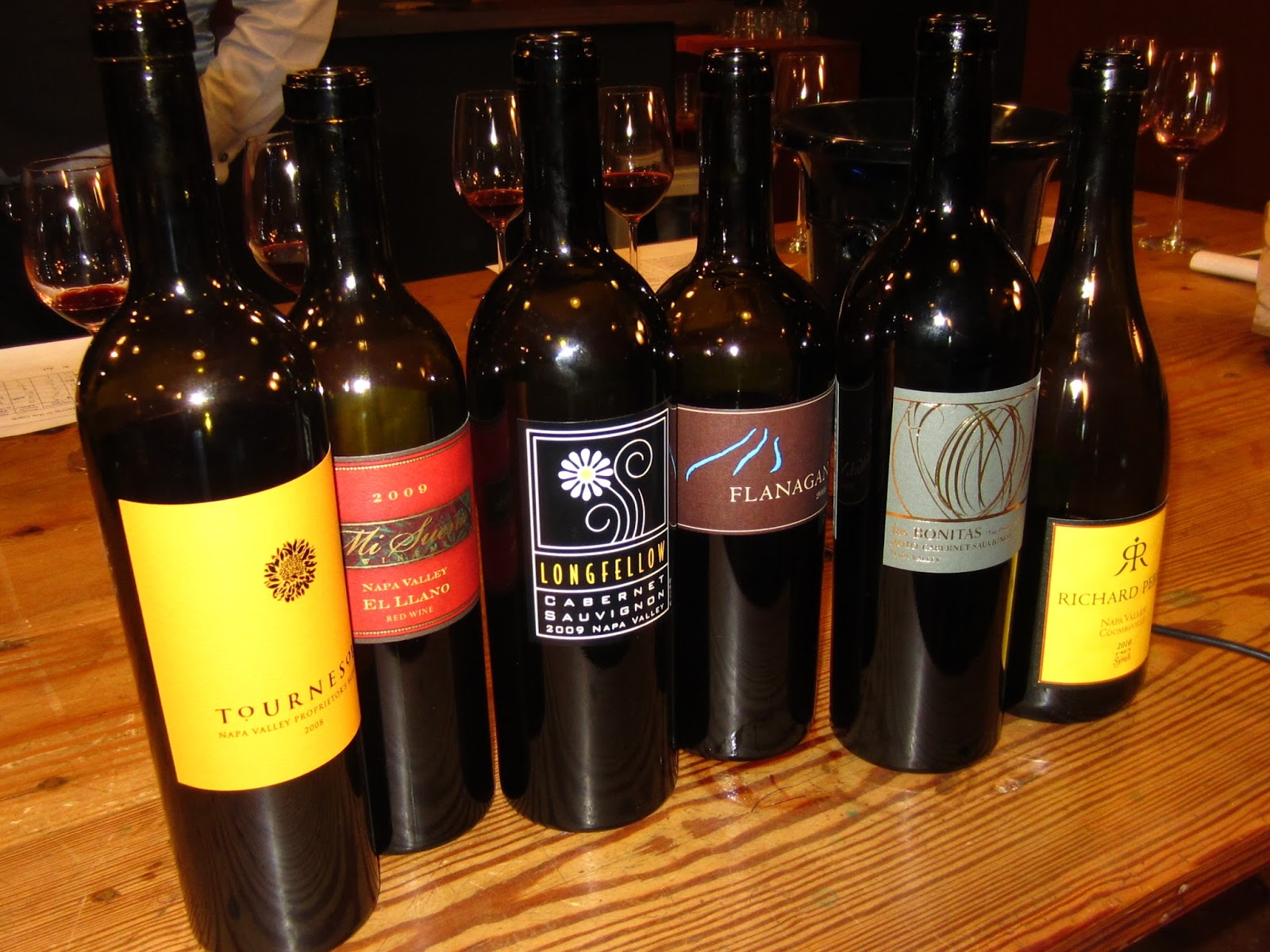
Garret selected the new Coombsville AVA as the “theme” he revealed after the wines were unmasked.  The only exception was a "ringer"produced in Bennett Valley, Sonoma - the Flanagan from Philppe Melka.  Following the blind tasting, the scores were tallied for each wine, and Garret Murphy’s own Las Bonita’s Grey label Cabernet earned the top score.  The small production wine’s first 2 releases were such a popular success that Las Bonitas was able to increase its production for the 2010 vintage. While Garret is the proprietor of Las Bonitas, the wine is crafted by the renowned Rolando Herrera, of Mi Sueno winery.  Herrera sources pristine fruit entirely from the newly recognized Coombsville AVA, southeast of downtown Napa and coaxes it to elegantly express the characteristics of anise, black fruit and coffee.
Below the 6 wines are listed in the order in which we tasted them with their rankings noted:


1) Richard Perry 2010 Syrah $40 RATED: #3
Blackberry, truffle and white pepper aromas combine with the nuances of leather and red licorice. The aromas echo on the palate framed by deep dark chocolate, brambly blackberry fruit and spicy tannins. The wine is lushly textured, round and soft with the underlying structure to continue to develop beautifully in the bottle.
2) Las Bonitas Cabernet Sauvignon 2010  $65 RATED: #1 (only 220 cases produced!)
This deep purple wine is packed with blackberry jam, classic aromas of earthiness, coffee ground and dried sage. Coupled with beautifully integrated tannins, this wine has a velvety mouth-feel with a complex and lingering finish. Well-structured, the finish persists revealing lightly toasted oak, spice and natural acidity.


3) Flanagan Cabernet Sauvignon 2008 $90  (Bennet Valley) RATED: #4 (only 363 cases produced)
This wine displays the classic Flanagan profile of red and black fruits, warm rock, and mocha. The texture of this Cabernet is elegant and reflective of both Sonoma’s cooler climate and 100% new French Oak.


4) Long Fellow Cabernet Sauvignon 2009 $60 RATED: #6
Dark and elegant, this wine is a  great classic expression of the newly minted AVA of Coombsville.  Brimming with ripe blackberry, huckleberry, black licorice, and black plum. Approachable young, but definitely age worthy.


5) Mi Sueno El Llano Proprietary Red Wine 70% Cabernet  30% Syrah  $40 RATED: #2
The smell of white pepper is accompanied with dried berries, black olives, roasted coffee beans and vanilla extract. Velvety tannins with balanced acidity makes for a food-friendly and versatile big red wine. It's mouth coating richness and spicy flavors will enliven your palate!


6) Tournesol Cabernet Sauvignon 2008 $75.00 RATED: #5
Delicate aromas of lavender, cinnamon and cedar sit atop the bolder notes of cassis, blackberry, plum, currants and raspberry. The palate is firm, concentrated and compact

exhibiting power and structure and even some flinty minerality.  A muscular wine you can enjoy now, or age for another 5-20 years.

Read more »

How to get a taste of California's Cult Pinot - Kosta Browne


My first experience with Kosta Browne was during one of the most blissful periods of my life.  Recently engaged to the husband of my dreams, one of our groomsmen and his wife invited us to join an intimate private dinner at the Tiburon Yacht Club that featured Kosta Browne wine pairings over a 6 course meal hosted by owners and winemakers, Dan Kosta and Mike Browne.  Almost 3 years later, I met up to taste with Dan and Mike again at their new winery in Sebastopol and was relieved to find that the memorable first experience with Kosta Browne was not merely a result of over-stimulated, pre-marriage oxytocin, but indeed induced by state of mind the high quality wine and unpretentious winemakers produce.  Kosta Browne has become one of California’s cult pinot noirs and is often used as a prototype by which to compare other pinots to.  This “Kosta Browne” style is flavorful, intense wines, concentrated and bursting with flavor.  These pinots appeal to Cabernet fans with similar flavor profile, but with the lower tannins and lighter body of a pinot noir, making them beautiful for pairing with a wide variety of foods.  According to Dan Kosta, there was no secret sauce formula that went into the creation of the first and subsequent appellation and single vineyard wines.  The bold flavors characterized by Kosta Browne were more or less attributed to the warm growing season of 2003 and 2004 which produced higher concentration in the fruit that Dan and Mike sourced selectively.  That coupled with the increasing demand and hype over pinot noir led to the sold-out, waitlist cult status that Kosta Browne brandishes today.


Heading back from a great trip to Mendocino and Anderson Valley, I was lucky enough to meet up with Dan Kosta and team at the end of a busy day.  Despite it being Presidents Day, Dan graciously offered to host me for a private tour of his new winery and tasting of the pre-released 2011 wines.  Located in central Sebastopol, the new Kosta Browne Winery is not open to the public, and took a few tries to find.  The construction workers hard at work gave away the site location, as did the “Winery Chic” architecture that stood out among the neighboring buildings, old warehouses that were built for processing fruit years ago.  “My wife was giving me a hard time for having them come to work today...I didn’t even realize it was a holiday!” Dan chuckled as I commented on how hard everyone was working.  Dan Kosta is jovial and larger than life. After an hour and a half with him, I got the distinct impression that he has an incredible work ethic and drive, but doesn’t slog through the days without creating some fun on the job. As we started tasting, he was testing out his new iphone app the controlled the central sound system in the barrel room and getting a kick out of tasting different wines to different genres...from Barry White to 80s rock.  Before the tasting, Dan gave us an abbreviated tour (it was freezing) of the new winery, opening on April 20th, which commands no less than 3 buildings and 44,000 square feet.  The 3 buildings consist of 2 barrel rooms (the wines have just been moved in to the new space), and a hospitality/production office building.  There’s also a central courtyard that can be used for hosting industry professionals and perhaps some member events.  While there’s a kitchen and space for entertaining special guests and wine industry folks, the winery won’t be open to the public.

So without a public tasting room, one would suspect that you would be able to at least order Kosta Browne wine or  join the wine club.  Unfortunately, the current wine club membership is maxed out at around 12,000 members and there are currently over 15,000 on the waitlist!  The wait for the appellation pinot noirs is approx. 2-3 years and about twice as long for the single vineyard wines.  The best best for getting a bottle of this coveted juice is to find it in a restaurant, and Kosta Browne has kindly listed all the restaurants that currently carry its wine here on their website, restaurants are listed alpha by state.  I found it on the list at Dixie, SF, two nights ago, and it was *not shockingly* the highest priced California pinot by the bottle on the list, and also the wine that the sommelier recommended to me (of course).  Coveted and rarefied as Kosta Browne’s name and status has become, Dan Kosta and Mike Browne are down to earth, with unpretentious backgrounds.  The two of them met while working at John Ash and Co. restaurant, Dan was running the wine program and Mike was working there  at night while interning at a Deerfield Winery during the day to learn how to be a winemaker.  In the summer of 1997, Dan and Michael decided to venture into winemaking, saving tip money for about eight months and eventually had enough to buy a half ton of Pinot Noir, a used barrel and an old hand-crank stemmer-crusher, a purchase that marks the beginning of Kosta Browne. Since that vintage, they have nurtured relationships with the best growers and select pinot noir and chardonnay from the choicest lots from Sonoma Coast, Santa Lucia Highlands and Russian River.  In 2001, Dan and Michael partnered with Chris Costello and his family, who collectively provided the business experience and relationships that gave Kosta Browne the necessary resources to grow. In 2003, the first 23 cases of pinot (sourced from Cohn vineyard) were bottled, labeled and distributed mostly for free to Dan and Mike’s favorite customers at John Ash.  In 2004 and 2005, the climate for grapes helped make Kosta Browne make pinot history with the intense flavor profile that led it to cult status.

So what’s next for Kosta Browne?  For one thing, Chardonnay was added to the portfolio two years ago and  has so far been a big success.  And, after 10 years of winemaking, Dan Kosta revealed to me he’s ready to try out the grape growing process.  Kosta Browne just purchased their first “estate winery” and his hope now is to become more than just a “Shepherd of the wines” and help cultivate the fruit itself.  As for the most recent vintages, they are taking a slightly more austere flavor profile, but are still elegant and balanced and even more appealing to me.  My notes on the 2011 pre-releases are below:

2011 Chardonnay:
Made with 50% New Oak and 50% 2 year old oak, this wine has screaming acidity and beautiful structure with bright flavors of lemon and citrus.
The flavors are succulent, fresh and lively on the palate, with a supple vanillin crème brûlée texture. The finish gradually turns crisp with a final wash of mouthwatering natural acidity.

2011 Pinot Noir - Gap’s Crown
This is the vineyard block that Kosta Browne just purchased.  The wine shows focused black plum and black cherry and ripe currants in the nose, followed by cassis and hints of dusting of cocoa.

2011 Pinot Noir - Kanzler Vineyard
Interesting notes of grapefruit on the nose,  and beautiful secondary notes of morel mushrooms, chocolate, and bright cherries.  This wine has a lot of soul and a slow release of complex flavors and textures, leading to a long and lingering finish.
Read more »

Decant You Can - Like a Pro


I believe one can never have too many decanters - those funny shaped decorative vessels used primarily to let wine breathe before serving.  Because a decanter is often displayed as a showpiece in addition to providing aeration, people are now purchasing decanters with extravagant shapes and qualities intended to draw attention. They may take the form of a long-necked "swan”, a cobra, or other unmentionable shapes with bulbous round bases and elongated necks that would make your grandmother blush the color of a fine rosé.  I encourage you to use your decanter and not let it collect dust or flowers on the shelf.  Here are three simple rules to have you decanting like a sommelier:


Rule 1: Determine whether the wine needs to be decanted.


The two veritable reasons to decant wine are to remove sediment and allow the wine to breathe. Typically, older, red wines are classic candidates for decanting, while young wines and white wines do not usually require it.  Many older wines will inevitably have sediment* and as anyone who has ever reached the end of their glass only to have the last sip full of a gritty, bluish gunk will tell you, it’s no picnic. However, it’s sometimes an appealing touch as a host/ess to decant a wine for guests and not purely for aesthetic reasons; I’d endorse decanting a younger full-bodied red or white wine to allow oxygen to get into the wine and accelerate the release of its aromatic and flavor compounds.

Rule 2: Learn how to properly decant wine:
The trick to decanting wine like a pro is to pour the wine into the decanter slowly and steadily, keeping the same side of the wine bottle down that was down during the aging process so as not to stir up the sediment. Before you begin, hold the decanter and wine bottle up with a white tablecloth, a light, or if you want to be traditional - a candle - to allow you to see the sediment in the bottle.  Slowly open the wine, and with a cloth, clean the inside and outside of the mouth of the bottle. Next, place either a candle or a light beside the decanter. As you pour the wine into the decanter, allow the light to shine through the the neck and shoulder of the bottle so you will see sediment as it starts to make its way into the neck. If you choose to use a candle, be very careful to not position the flame too closely to the bottle so you don’t warm the wine as it makes its exit. As the sediment starts to approach the neck of the bottle opening, this is your sign to stop pouring the wine into the decanter.  Once this happens, carefully set the bottle down and let it settle for several minutes.  If you’re keen on it, you may then try again, to potentially squeeze a little more clear wine away from the remaining sediment.

Rule 3: Determine when the decanted wine is ready to drink
Now that the wine is safely in the decanter, its rich color can be viewed through the clear glass and its aromas are being generously released into the air. This leads me to the second benefit of decanting wine and back to why these vessels are shaped so strangely. The decanter is shaped specifically to allow the maximum amount of surface area for air to hit the wine. While during the years of aging you don't want the wine exposed to air due to oxidation damage, now that you're ready to drink it, getting oxygen across a good surface area of a wine will draw out its aromas, which enhances your ability to taste the wine completely.  Once in the decanter, you might pour a small amount into your glass and leave the rest, letting it open up for a little longer. Generally a half to one hour is a good amount of time to let the wine fully open up, and you will continue to see the wine flavors change throughout the evening as it continues to breathe. Never let the wine sit out for too long – after a day or so of exposure, most wine will be on its way to becoming expensive vinegar.  Generally speaking, as soon as an older wine is opened there’s a fine timeline between it opening up and losing its character, so leaving it in the decanter for several hours (as you might with a younger vintage) will not benefit the wine or you.

If you ever find yourself in a situation where you are pressed for time and need to quickly decant/aerate a wine, I’ll share a tip I learned from a famous sommelier that you can take with a grain of salt (or sediment).  Take that beautifully decanted wine, and pour it into a clean blender and pulse the “blend” button several times. Believe it or not, this will aid in accelerating the aeration process - and can be a fun way to completely shock and awe your guests while producing a glorious result.  If you’re not sure whether to decant a wine just remember - yes you can.

*Sediment forms in red wine when tannins and anthocyans (wine’s coloring agents) interact, forming large, complex molecules that eventually grow too big to remain soluble and precipitate as sediment. This is why high quality, concentrated red wines with more skin exposure tend to accumulate more sediment.
Read more »

Pinot is King, but here are 4 Sexy Alternatives for the Savvy SF Wine Drinker


Let’s face it - America’s obsession with Pinot has gotten a little bit out of control.  Attribute this to the movie “Sideways” or its incredible versatility, elegance and food-friendliness, but Pinot Noir has become the darling of the wine industry.  It’s the grape most desired, with the price point to match.  While the nectar is good, the ensuing price escalation is hardly palatable for most newly weds saving for the future.  Furthermore, as winemakers meet the demand, the Pinot Noir gold rush has supplanted many interesting, noteworthy varietals.  This article looks to highlight these underdog grape varieties, which embody many of the same great qualities we admire in Pinot Noir, including: high acidity, balance, fruit-forwardness, moderate to low tannins and compatibility with food - and they’re downright sexier to order.  Just like Pinot Noir, these Pinot peers range in style and seduce with both their bright red, fruity qualities as well as their earthier notes and pair with a range of foods accordingly.  Since variety is the spice of life, below is your guide to four intriguing Pinot alternatives from around the world, along with their most compatible food pairings.  

Dolcetto:
Pronounced "dole-chetto," this grape may be named for the Italian phrase “little sweet one,” implying high sugar levels, these wines are typically drier in style and hail from Italy’s Piedmont region.  Dolcetto is medium bodied, light and fruity with moderate levels of acidity and meant to be consumed one to two years after release.  This translates to great affordability for how delicious and suave they can be.  Dolcetto expresses cherry and baked fruit flavors, and are known for a slightly bitter finish reminiscent of almond skin. It’s an excellent everyday drinking wine as it pairs with a great variety of foods. Try this smooth Italian with pastas and pizzas, sausage or pork.


Top Examples to try: Luigi Einaudi Dolcetto di Dogliani Vigna Tecc, Palmina Dolcetto Santa Barbara County, Fratelli Brovia Dolcetto d'Alba Solatio

Gamay
This overlooked grape comes from Beaujolais, pronounced “bow-jol-lay,” the winemaking region just south of Burgundy in France and has long been thought of as a Pinot Noir clone. In contrast to the Pinot variety, Gamay typically ripens two weeks earlier, is less difficult to cultivate and is more abundant than Pinot. Gamay grapes are often blended but can be made into beautiful single varietal wines that are medium to light bodied with intense acidity.  They have floral aromas of lilac and violet and exude hedonistic flavors of crushed raspberry, strawberry, and red cherry fruit as well as distinct herbaceous qualities, making them downright incredible with foods. Gamay is a wonderful pairing for any dish that features mushrooms, cured meat and pâté, veal or roasted duck.

Top examples to try: Domaine Geoffrenet-Morval Cuvée Comte de Barcelone, Domaine Chignard Cuvée Spéciale Gamay Fleurie, Mommessin Les Caves Grand Exception Gamay Moulin-à-Vent

Frappato
The Italian island of Sicily is also home to a lovely aromatic indigenous grape called Frappato. This gorgeous grape produces beautiful, cherry blossom-scented wines that express the subtlety and delicacy you might find in a Willamette Valley Pinot Noir. These wines typically aren’t aged in oak but rather in stainless steel tanks, which affords them to retain a very light and pure style.  Frappato exudes fruit flavors of strawberry jam, blackberry and bing cherries. Try pairing Frappato with herb roasted chicken, veal or couscous.

Top examples to try: Arianna Ochipinti, Valle dell'Acate, Il Frappato, Duca di Salaparuta, Calanìca

Grenache:
One of the world’s most versatile and widely planted grape varietals, Grenache is my pick for the biggest up and comer in the wine world.  Its bright berry flavors with hints of spice and soft tannins make it easy on the palate and excellent to pair with a multitude of dishes.  If you lean towards more fruit-forward, California Pinots (think Kosta Browne) you’ll adore grenache with its tendency towards higher alcohol content and a chewier, full body and mouth feel.  The characteristics that make this wine a great alternative to Pinot are its red berry fruit palette such as wild raspberries and strawberries, and its ability to develop complex secondary earthy and herbal notes such as black olives, coffee, gingerbread, black pepper and leather.  Grenache is also a grape that is commonly made into rose, which is another great light wine to pair with foods and a wonderful daytime wine alternative.  Try pairing grenache with your Thanksgiving turkey, rabbit, game such as venison, and roasted root vegetables.

Top examples to try: Argiolas 1997 Turriga Grenache, Zaca Mesa, Santa Ynez Valley, California, Clos Erasmuth, Priorat
Read more »

JUST IN! New Online Mag - Wine Country Weddings - Your Guide to Sparkling Wine found here!


I'm so thrilled to be part of this amazing new online wedding magazine.  It's beautifully crafted and full of only the best resources for planning a wine country wedding.  Check out the wine section for my article on sparkling wines that pair with every course...

http://winecountryweddingsmagazine.com/

PRESS RELASE:
New Online Wedding Publication, Wine Country Weddings Magazine: 
Napa Valley, Ca. (April 2, 2012) - Based in beautiful Napa Valley, Wine Country Weddings Magazine was founded by Autumn Millhouse, author of Romantic Napa Valley: An Insider's Guide for Couples, who has also held titles that include Associate Editor, San Francisco Brides Magazine, Lifestyle Editor, Napa Valley Life Magazine and has been a contributor to various publications such as Exquisite Weddings Magazine, Tour & Tasting Magazine, and Destinations: I Do Magazine.
The inspiration for the magazine was the endless inquires from couples who read her book, articles and blog, and were now engaged and wanted her advice on getting married in wine country. Thrilled to share her passion for wine country (she’s a third-generation Napa Native), and affection for love stories, romance and the idea of happily-ever-after, the magazine creation has turned into a true love affair. Combined with a team of talented contributors who are also hopelessly romantic, Wine Country Weddings Magazine is the premiere magazine for wine country brides.
The magazine is released two times a year, Spring & Summer and Fall & Winter, and is updated quarterly with a new cover. Inside the magazine there are feature sections that include wine, food, romance and style. Also, inside the magazine is the Bridal Resource Guide, which feature  California wedding venues, photographers, bridal vendors, sweetest desserts and treats, and rehearsal dinner hotspots. The blog features real wine country weddings, tasting notes on wine, signature cocktail recipes, wedding décor ideas, DIY wedding projects, bridal style and much, much more.
For any additional information, questions or images please contact Autumn Millhouse directly at autumn@winecountryweddingsmagazine.com.


Read more »

10 Great Wines you should Buy and Cellar Now


Wine is one of the special things in life that can get exceedingly better with age. Unfortunately, collectible bottles get very expensive, and one of the biggest regrets I hear from collectors is that they didn’t start collecting great wines while they were young and affordable. I grew up watching my father’s wine cellar collection expand and was always excited when he’d make a trip down to the cellar and bring up special bottles to pair perfectly for holidays and special occasions. To me, this is one of the reasons I always came to associate wine with love, happiness, celebration, family, and festivities. The gift my Dad gave my husband and me for our wedding is very dear to my heart - he researched and selected 10 wonderful wines from around the world and nearby Napa that would age beautifully for the next 10 - 40 years, gifting us a case of each of them (they're currently being stored in perfect temp-controlled space in my Dad's cellar - photo credit above goes to Garrett Gaudini). This gift is perfect because as we grow older together, we’ll also be able to celebrate our marriage milestones by opening up these wines - and it's a good thing they aren't stored in our home here in San Francisco, because I'd be lying to say I wouldn't be tempted to open up a bottle or two before they've reached their prime. I look forward to growing old and enjoying these beautiful wines with my husband, family and friends for years to come. Below are the ten wines we’re cellaring, with notes and ratings - and if you're temped to open them, you can always consider storing them at an "off premise location" such as the Wine Center SF, where you can assure your "wine investment" is going to rest safe and sound until you're ready to enjoy!

2007 Chateau Montelena Cabernet Sauvignon - Napa

By Stephen Tanzer
Saturated, deep ruby-red. Deep aromas of blackberry, blueberry, violet and minerals; Silky on entry, then dense and sweet in the middle, conveying an impression of power. There's a youthfully medicinal quality to the dark berry and licorice flavors but unusual early sweetness and pliancy to this long-aging wine. Finishes with very suave tannins and impressive persistence. This is actually 14.3% alcohol, which is unusually high here. Barrett could only recall the 2004, 1994 and 1978 surpassing 14%.
Rated 93 Points Stephen Tanzer's International Wine Cellar

2007 Nickel & Nickel Cabernet Sauvignon John C. Sullenger Vineyard
By Stephen Tanzer, Stephen Tanzer's International Wine Cellar
Bright medium ruby. Bordeaux-like nose offers cassis, black cherry, graphite, mocha and leather. Lush on entry, then suave in the middle, with redcurrant, plum, licorice and mocha flavors given definition by harmonious acidity. The dusty, building tannins spread out horizontally to coat the palate. (Nickel & Nickel was established in 1997 by the partners of Far Niente with the objective of producing 100%-varietal single-vineyard wines from Napa and Sonoma Valleys.)
Rated: 92 by Stephen Tanzer

2007 Palmaz Estate Cabernet Sauvignon - Napa
JancisRobinson.com
This acclaimed vintage exhibits a concentrated balance of dark fruit flavors and opulent oak notes with beautiful transitions throughout. The structure of this wine promises to age elegantly with an abundance of fine grained tannins exhibiting our signature style of supple rich texture. This is a vintage of extraordinary depth and complexity and has lived up to all the anticipation for this renown Napa Valley vintage.
Rated 93 Points on Cellar Tracker.com

2009 Peay - Pinot Noir Ama Estate - USA - Sonoma Coast
By Josh Raynolds - Stephen Tanzer's International Wine Cellar
Vibrant red. Pungent, sexy aromas of black raspberry, cherry pit, cocoa powder and incense. More serious, even masculine, compared to the Pomarium. Fresh and gripping, with impressive sappiness and extract to its dark berry and bitter cherry flavors. Finishes vibrant and very long, with palate-dusting floral, mineral and spice nuances. This is the inaugural vintage for this wine, which is sourced from a section of the Peay vineyard that's planted to a suitcase clone and Dijon clone 828.
Rated 93 points by Stephen Tanzer

2008 Figeac St Emilion
View From the Cellar - By John Gilman
The 2008 Figeac is a beautiful bottle in the making and was clearly one of the best 2008s on display at the UGC tasting. The bouquet is deep, complex and utterly classy, as it jumps from the glass in a stunning blend of red and black cherries, raw cocoa, tobacco smoke, coffee, complex soil tones and vanillin oak. On the palate the wine is deep, full-bodied, complex and very elegant out of the blocks, with excellent mid-palate depth, ripe tannins and outstanding length and grip on the youthful and very pure finish. Figeac is of course raised in one hundred percent new wood, so it always shows a bit more flamboyantly at this early stage than wines such as Canon, and it will be very interesting to compare these two classics a decade or two down the road. A great vintage of Figeac. 2018-2045+.
Rated 94 points by Wine Enthusiast

2008 Montrose, St-Estèphe
View From the Cellar - By John Gilman
Château Montrose is making such profound and classic wines these days that it is hard not to argue that this is the golden age for this estate! The 2008 Montrose is a great, great wine in the making, as it offers up a deep and very complex nose of black cherries, cassis, Cuban cigars, a wonderfully complex base of gravel, espresso and cedar. On the palate the wine is deep, tight and very, very pure, with a rock solid core of fruit, stunning soil signature, plenty of firm tannins and plenty of lift on the backend from the superb acidity of this vintage. The finish here is very, very long, displays excellent focus and grip and is still very, very closed. This great wine will live forever, but will take at least a good dozen years to blossom. Under the direction of Jean Delmas, Château Montrose is the claret purists’ perfect wine. 2022-2100.
Rated 95 points Robert Parker, 94 Points by Wine Enthusiast

2008 Grands Echézeaux- Domaine Mongeard-Mugneret
View From the Cellar - By John Gilman
For as long as I can remember, Domaine Mongeard-Mugneret has produced one of the greatest examples of Grands Echézeaux in all of Burgundy, so it comes as no surprise that their 2008 is stupendous. The absolutely beautiful, youthful nose soars from the glass in an inspired mélange of dark berries, plums, espresso, woodsmoke, incipient notes of gamebird, a kaleidoscopically complex base of soil and a judicious base of cedary oak. On the palate the wine is deep, pure and very primary, with a rock solid core of fruit, laser-like focus, beautiful, nascent complexity, ripe, seamless tannins and tangy acidity lifting all these elements in a peacock’s tail of transparency and purity on the very long finish. This will be an absolutely brilliant example of the vintage, and a decade down the road, it may well prove that I have slightly underrated this beautiful wine. 2018-2060+.
Rated 95+

2006 Domenico Clerico Barolo Pajana
By Stephen Tanzer - Stephen Tanzer's International Wine Cellar
Good full red-ruby. Knockout nose offers dark cherry, strawberry, dried flowers, cedar, tobacco, leather and musky spices. Silky and sweet on entry, then powerful in the middle, with a firm spine of acidity giving lift and cut to the wine's red fruit, tobacco and dried flower flavors. Offers a compelling balance of stuffing and energy, and has the sheer fruit extract to buffer its ripe tannins. This really spreads out to saturate the palate, and is riper and more harmonious than the 2005 bottling. Anticipated maturity: 2016-2031.
Rated 93 points - StephenTanzer

2004 Bodegas Muga "Prado Enea" Gran Reserva Rioja
Robert Parker’s Wine Advocate

The 2004 Prado Enea Gran Reserva is not quite as dense as the 2005 but is more expressive on the nose and rounder on the palate. Dark cherry, orange edge. Complex aromas, spicy, toasty, fine cocoa, fruit expression. Palate: powerful, full, rich, spicy, ripe tannins. Complex bouquet, spicy, fine wood and leaf, stewed fruit. Balanced, with body and nerve, tasty, ample. It is a complete effort that should prove to be one of the best Prado Eneas Muga has produced.
Rated 94 points Robert Parker's Wine Advocate

2007 Le Clos du Caillou Chateauneuf du Pape Les Quartz
The Wine Advocate
The prodigious 2007 Chateauneuf du Pape Les Quartz (85% Grenache aged totally in foudres and the rest Syrah, which is aged in small barrels) has terrific floral, raspberry, and black cherry notes intermixed with a striking minerality and precision. A Musigny grand cru Burgundian style of wine, with power and elegance, a thoroughly compelling flavor profile, and a rich, intense finish, the tannins are sweet and the well-integrated acidity gives uplift to the wine. Stunningly proportioned yet never heavy, this is a sensational wine that should only get better over the next few years and last for 15 or more.
95 Points - The Wine Advocate


Read more »
 

Copyright © 2010 • Decantress Wine Diary • All rights reserved